Entanglement & Non-locality
Quantum entanglement is not merely a strange curiosity: it is a new way of linking systems that are extremely far apart. Thanks to it, one can blur and then “restore” interference fringes (quantum eraser), transfer the state of a photon without moving matter (teleportation), and generate encryption keys that even a supercomputer cannot break. In Consciousness of the Real (CdR), these phenomena are viewed as different expressions of the same idea: particles far from one another remain traces of a single underlying geometric structure, denoted Φ, which imposes their correlations and suggests new tests (Q1–Q3) to compare CdR with standard quantum mechanics.
Quantum Entanglement
Step 1 — Birth of quantum twins.
An ultraviolet laser passes through a special crystal that converts some photons into twin pairs. They are called A and B. They are born together, like two notes from the same chord: from the very beginning, their properties are linked.
Step 2 — The invisible link persists.
The two photons travel in opposite directions — sometimes a few meters apart, sometimes hundreds of kilometers. As long as nothing perturbs them too strongly, their quantum link remains intact: changing the measurement conditions on one side immediately modifies the correlations observed on the other, without any signal traveling faster than light between them. This is what Einstein called “spooky action at a distance.”
Step 3 — Proof through measurement.
Alice and Bob orient their polarizing filters at different angles and then compare their results. One then observes extremely precise correlations, exceeding what any classical hidden-variable theory would allow. These are the famous Bell tests: nature consistently answers in favor of the quantum world.
What Consciousness of the Real (CdR) adds:
Rather than imagining two separate objects that “communicate” at a distance, CdR describes entangled photons as two manifestations of a single Φ structure. At their creation, a simple constraint links their internal phases (φ_A + φ_B = φ₀) and remains inscribed in the substrate. The observed correlations thus become the reflection of this shared geometry, without spooky action or violation of relativity. CdR also predicts subtle effects — such as dependence on certain local gradients and a specific transition at very long distances — allowing this interpretation to be tested against the standard theory.
The Bell test
Step 1 — Creating entangled pairs.
In a modern Bell experiment, a source continuously produces entangled photon pairs. One photon is sent to Alice, the other to Bob, sometimes separated by several kilometers. Each pair forms a small “A + B” system to be tested.
Step 2 — Measurements with random choices.
To avoid any hidden coordination, Alice and Bob choose their analyzer orientations randomly and at the last moment. Alice selects between two possible angles; Bob does the same. They cannot coordinate: their choices are independent in space and time. At each trial, each observer obtains a simple result: “pass” or “no pass.”
Step 3 — Violation of classical limits.
After thousands of measurements, the results are combined to compute a number called the Bell parameter. Any local classical theory imposes a strict upper bound on this value. Experiments systematically exceed it, matching the prediction of quantum mechanics. This is the experimental signature of entanglement: no purely classical model can reproduce these correlations.
What Consciousness of the Real (CdR) adds:
CdR interprets this violation as the direct consequence of a geometric constraint inscribed in Φ at the moment of pair creation. The photons do not “decide” their outcomes at the last instant; they follow a common structure that links their internal phases and, through local analyzers, produces exactly the correlations observed in Bell tests. The theory further predicts slight deviations at very long distances or in the presence of strong substrate gradients, offering future experiments to discriminate between CdR and the standard description.
Multi-Photon Entanglement
Step 1 — GHZ states: all or nothing.
When entangling not two but three, four or more photons, one can construct so-called “GHZ” states. All photons are bound by a single global constraint: either everything remains perfectly synchronized, or the entire state collapses. This produces very strong correlations but also extreme fragility: losing a single photon destroys the whole system.
Step 2 — W states: protective redundancy.
“W” states distribute entanglement across several possible paths. For three photons, the excitation may reside on one or another, in a balanced superposition. This redundancy makes the state much more robust: even if one photon is lost, the others remain entangled. Experiments confirm that W states tolerate losses that GHZ states cannot.
Step 3 — Structure determines robustness.
The GHZ/W comparison shows that it is not the “amount of entanglement” that matters, but how it is organized. A single global branch (GHZ) yields maximal correlation but high fragility; multiple redundant branches (W) provide resistance to decoherence. Experiments increasingly map these behaviors as the number of particles grows.
What Consciousness of the Real (CdR) adds:
CdR interprets these differences as a direct expression of the topology of the Φ substrate. A GHZ state corresponds to a unique global mode with a single failure point shared by all particles. A W state corresponds to several overlapping local structures, like a bridge supported by many cables. This geometric reading allows the fragility of GHZ and the robustness of W to be derived, not merely observed. CdR yields quantitative predictions for decoherence rates and tolerable loss fractions, testable with current technology.
Quantum Eraser and Teleportation
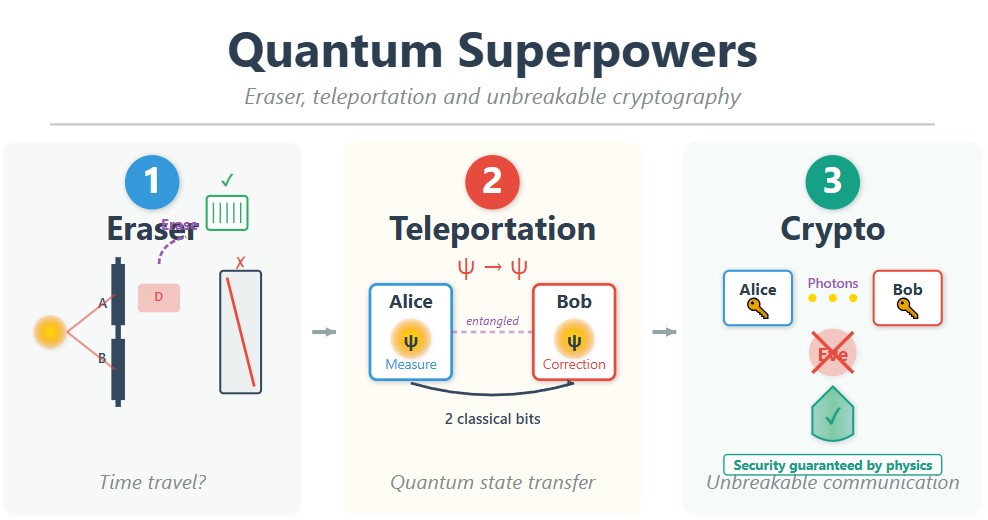
Step 1 — The quantum eraser: reversing time?
In a double-slit setup, one can mark the path taken by a photon. Interference fringes then disappear: the photon behaves like a classical particle. If this which-path information is later “erased” in an entangled branch of the experiment, interference reappears — but only after sorting the data appropriately. It may appear as if the past has been modified, whereas in reality events are merely reclassified. Causality remains intact.
Step 2 — Quantum teleportation: the state without matter.
Alice possesses a photon in an unknown state and shares an entangled pair with Bob prepared beforehand. By performing a special joint measurement on her photon and her half of the pair, and then sending two classical bits of information to Bob, she enables him to transform his photon so that it exactly reproduces the original state. The state is transferred, not the particle: no cloning, no faster-than-light signaling, but a new way of connecting distant laboratories.
Step 3 — Quantum cryptography: self-defending keys.
By combining entanglement with random measurements, Alice and Bob can generate a shared secret key. Any attempt at eavesdropping inevitably disturbs the quantum correlations and produces a measurable error rate. If it exceeds a threshold, an intruder is detected and the key discarded. Otherwise, the key is secure regardless of the adversary’s computational power.
What Consciousness of the Real (CdR) adds:
CdR unifies these three protocols under a single picture: all exploit the geometry of the Φ substrate. In a quantum eraser, Φ motifs are split and recombined; in teleportation, a pre-existing constraint between Alice and Bob is used to reconstruct a state locally; in cryptography, any spy must couple to Φ and therefore leaves a detectable trace as additional decoherence. Beyond reproducing standard predictions, CdR proposes three experimental signatures (Q1–Q3) affecting erasure efficiency, teleportation fidelity versus distance, and QKD key-rate profiles — concrete ways to test this geometric view of the quantum world.
Further reading
This popularized presentation is based on the technical documents of the Entanglement & Non-locality series:
- image066 — EPR Entanglement — Joint Configuration and Non-Factorizable Correlation
- image067 — Bell-CHSH — Critical Test of the CdR Joint Configuration
- image068 — Multipartite Entanglement — GHZ, W, Cluster, and Generalization Constraints
- image069 — Advanced Entanglement Protocols — Eraser, Teleportation, QKD, and Networks
These documents detail EPR entanglement, the Bell-CHSH test, multipartite configurations, and advanced entanglement protocols in the CdR framework.
CdR methodological framework — Unifying tests and validation
The results presented in this section rely on the six-step analysis protocol defined in the CdR series. This protocol establishes the coherence, maturity, and falsifiability criteria governing technical documents 066–069.
- image070 — Critical Framework for the 6D Vortex — Validation of Steps 1–6
This document provides the conceptual structure of the “Entanglement & Non-locality” domain.