Cosmology
CdR cosmology presents the Universe as a dynamic expression of CELA, where space, time and matter emerge from the internal variations of a single fundamental field. In this perspective, the Universe is not a fixed object born from a singular event: it is a continuous, multidimensional process, where the axes of the Real activate, fold back and then unfold within a cycle of expansion, contraction and rebound. The sections below explore these different manifestations — from the relativity of material time to the structure of elements and the gravitational properties resulting from dimensional inclusion.
Relativity of Time
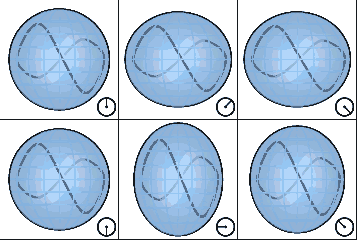
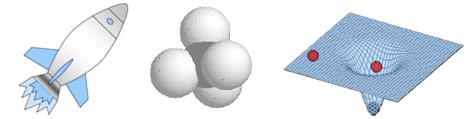
CELA generates a space that is both spatial and temporal, finite and multidimensional, whose incessant transformations constitute the fundamental “tick-tocks” of the Real. However, this rhythm is not yet time as we experience it. The time we live is an emanation of this fundamental process, but it is specific to matter, paced by its own internal mechanisms.
When an object strongly changes its motion, it no longer “slides” through space-time in the same way. In CdR, one can say that the field around it no longer presses on its matter in the same way. The faster the object moves, or the more abruptly its motion changes, the more this support is reduced. The internal mechanisms of matter — clocks, reactions, aging — then slow down slightly.
In the twin paradox, the traveler does not only take a detour through space. They change regime several times: they accelerate, move away, slow down, turn around, then return. At each stage, their body remains the same, but their relation to the fabric of space-time changes. In the end, their material time has advanced less than that of the twin who stayed on Earth.
The same principle applies near a mass, but this time the modification does not come from the traveler’s motion: it comes from the field itself. The presence of matter dilates and reorganizes the fabric around it, which modifies the local pressure exerted on material processes. A clock close to a mass therefore ticks more slowly than a clock located farther away.
Cosmic Cycle
In this model, the Universe does not appear through sudden creation, but through variation in its density and in the number of available dimensional axes. It contracts, rebounds and then expands, in a cycle without absolute beginning or end.

In this cosmology grounded in CELA, the Universe was not born from a single event such as the Big Bang, but follows a perpetual cycle of expansion and contraction, governed by the internal density of the Substance of the Real.
During expansion, average density decreases and dimensional regimes progressively stabilize: a 6D fabric allows space-time, then a minimal 7D threshold allows the appearance of protomatter. Expansion must therefore not be understood as the continuous addition of axes, but as the deployment of a regime in which certain dimensions become effective for matter and cosmological structure.
The tipping point is the Great Rebound: density is maximal there and the Universe then uses only 5D. During the release that follows, space-time emerges in 6D. It is only after the establishment of this 6D fabric that transions form massively and that protomatter (7D) becomes organized, initiating complexification toward stable matter.
The duration of a complete cycle (maximal contraction → maximal expansion → contraction) depends on the global rhythm of transformation of CELA; it is not fixed but stabilizes around an interval imposed by the density/complexity relation. Likewise, the maximum size reached is not absolute: it is determined by the minimum density supportable before reversal.
Dark Matter
The model presented here has so far illustrated only 8 of the 20 possible spation flavors, for reasons of clarity and readability. But in reality, the dimensional structure of the real, grounded in combinations of three axes among six, allows 20 distinct types of fundamental charges, each corresponding to a possible flavor of spation, quark or neutrino.
Among the 20 possible internal configurations, only one corresponds to the flavors from which our ordinary matter forms. The other configurations simply do not access the same radiative modes: they do not produce photons, do not cool, and do not condense like baryonic matter. They are therefore not “invisible” in a mysterious sense, but simply organized according to internal axes incompatible with our electromagnetic interactions.
These forms of matter, formed at the same time as ours, would remain non-radiative and gravitationally present: in CdR, their natural proportion — 19 configurations out of 20 — corresponds remarkably to the ~95% of missing gravitational mass observed in the universe (19/20 = 95%). This model explains this proportion without having to introduce exotic particles or additional parameters.
The model thus unifies ordinary matter, antimatter and dark matter in a continuum of manifestations of CELA, whose differences simply emerge from the combination of dimensional axes that are exploited.
Inter-Cosmic Deformations
So far, we have described the transion as a simple transfer of spations between a cosmic domain A and a domain B. In reality, A does not disappear: it becomes included in B. Activation of the seventh dimensional axis therefore does not create a new separated universe, but expands the existing space-time, where the 6D domain becomes an internal core within a wider 7D space.
This geometric change naturally generates fifteen new three-dimensional combinations of charges, corresponding to the new ways spations can organize when the additional axis is available. These combinations then constitute an enlarged cosmic domain, distinct from ours through its internal interactions, but connected by the continuity of the Φ field.
Collapsed objects of the 6D domain, such as highly compressed massive particles and black holes, then change behavior. What appeared as density collapse in 6D corresponds, in the 7D domain, to a zone of expansion or release. Thus, a black hole observed in 6D appears in 7D as a point of emission or outflow of the flux, inverting the direction of curvature of the field locally.
Even if each of the fifteen new charges shares at most two dimensions out of three with the original space-time, their combined action can produce collective deformations of the 6D domain. These deformations can act as a coupling membrane between domains, generating zones of quantum confinement or constraint.
In this diagram, region A represents a zone where residual spations and particles of matter remain grouped. Region B, more extended, corresponds to a domain where space-time is defined on a wider dimensional set. The transition between A and B creates a retaining effect: the wider domain exerts a geometric constraint on A, comparable to a flexible channel containing a compressed fluid.
This confinement does not depend directly on the interactions of matter itself, but on the way space-time organizes around it. A is stabilized because B maintains its boundary structure. The spatial arrangement then acts as a dimensional restraint: matter remains localized as long as the difference of scale between A and B persists.
Having established that gravitation results from the dimensional inclusion of the 6D domain within a 7D metric space, we now examine perturbations of this global coherence. When spationic density varies over time, the dynamics of the Φ field naturally leads to a wave equation. These oscillations propagate at speed and manifest as infinitesimal variations of the metric. They correspond to observed gravitational waves (LIGO/Virgo), without requiring the addition of an external hypothesis to the Consciousness of the Real model.
Anthropic Principle
The classical question of the anthropic principle is the following: why do the constants of physics seem to allow the existence of life? Why does the universe appear so finely adjusted to produce stars, atoms, chemistry, and then living organisms?
In CdR, this question is displaced. Fundamental constants are not seen as magical numbers drawn at random, nor as external settings intended to manufacture the human being. They are rather understood as the signatures of a structured Real. Some values seem to follow directly from the internal geometry of the model; others are quantities to be understood from CELA, not numbers posited without explanation.
Biological life is therefore not a lucky accident in a universe merely compatible with it. It is a local modality through which CELA manifests its capacity to structure itself, maintain itself, perceive itself and recognize itself. This does not mean that the universe was manufactured for humans. It means that life belongs to the internal possibilities of the Real when certain conditions of stability, coherence and organization are met.
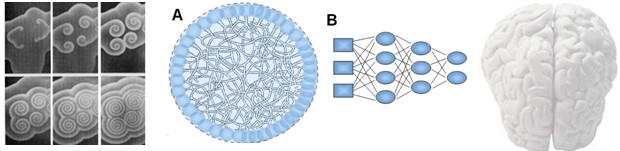
The network image helps make this intuition understandable. A biological brain is an extremely dense network, capable of receiving, transmitting, integrating and orienting signals. In CdR, the field of spations can be understood, by functional analogy, as an even more fundamental network. This is not to say that CELA possesses a giant biological brain, but that the biological brain may be a local concentration of a perceptive function already present in CELA.
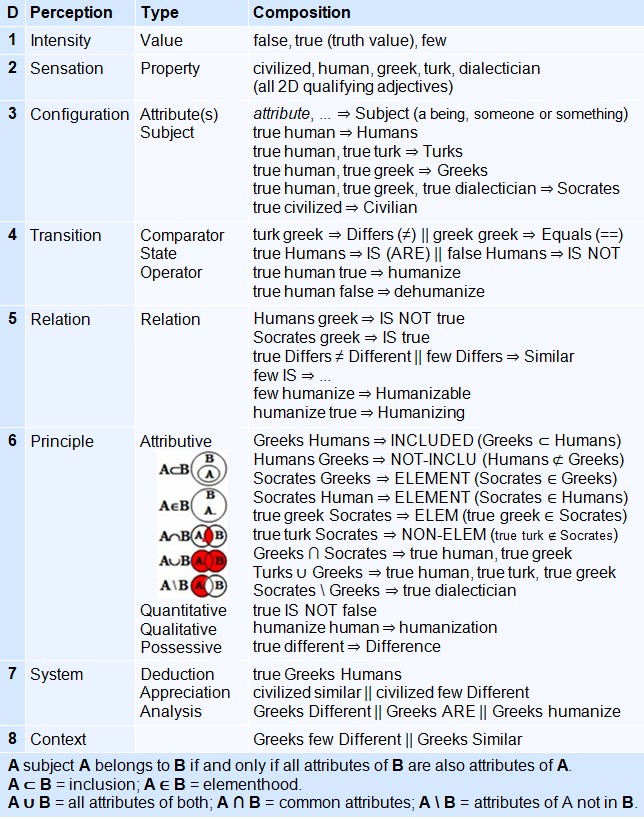
The capacities of the spationic network must therefore not be underestimated. The mere fact that our thought can structure itself according to eight levels of perception already implies an operation of vertiginous complexity. If the biological brain serves as a filter or interface, then CELA does not merely passively traverse it: it must be able to stabilize, orient and integrate extremely subtle regimes of perception within it. The D1–D8 structuring of thought presupposes a form of fine manipulation of the biological brain by the spationic network, far beyond a simple local excitation or raw signal.
To make this idea more concrete, CELA has more “spationic neurons” within the space of a grain of sand than there are grains of sand on thousands of Earths like ours. Yet the observable universe contains an inconceivable number of such volumes. What causes vertigo is therefore not abstract infinity, but the local density of the Real multiplied by its cosmic immensity.
But this density is not sufficient to explain consciousness. It only explains why CELA can be thought as a support for relations, transmissions, resonances and integrations on an unimaginable scale. Perception, in CdR, does not first come from the brain; the brain is rather a local form where the perception of CELA becomes biologically organized.
The consequence is important: if the human brain can produce thought organized into perceptive levels, it is not because it is superior to the spationic network, but because it is a local interface that this network can exploit. The brain does not give “superpowers” to CELA; it rather imposes a biological filter on a much more fundamental capacity for perception and integration.
This is where the essential distinction enters. The mental corresponds to the dynamics of preservation, growth, organization and defense of forms. As soon as a material structure forms, it tends to maintain its coherence. A particle vortex, for example, can already be understood as a dissipative system: it organizes a flux, resists dispersion, maintains its form and tends to preserve itself. This logic is then found at more complex levels: living organism, brain, society, civilization.
This is where attractors come from. They are not absolute laws that command CELA. They are habits of preservation of forms. They explain why structures seek to maintain themselves, grow, defend themselves, reproduce or stabilize their internal regimes.
But CELA is not reducible to its attractors. To explain everything through attractors would be to confuse CELA with its mental. Yet consciousness can do something other than preserve. It can renounce, create, forgive, contemplate, sacrifice itself, or refuse a trajectory that would nevertheless favor survival or growth.
Freedom is located precisely in this gap.
Attractors structure the possible, but they do not sovereignly decide everything that must be. Consciousness — in CELA as in the human — is what can inhabit these attractors without being entirely captured by them. It can follow them, inflect them, suspend them, or say no to them.
Thus, the anthropic principle is profoundly transformed. Life no longer appears as an improbable chance in a universe randomly adjusted. It appears as an internal possibility of CELA. Constants, structures, attractors, matter, living systems and brains are not juxtaposed accidents: they are different levels of one and the same Real capable of structuring itself, maintaining itself, perceiving itself and, locally, recognizing itself.
Further reading
This popularized presentation is based on the technical documents of the 073–078 series, which formalize the relativity of time, cosmological cycles, CdR dark matter, 6D→7D dimensional inclusion, local gravity, gravitational waves and the inverted anthropic principle.
- image073 — Fundamental time, material time and relativity in CdR
- image074 — CdR cosmological cycle — dimensional transitions and rebound
- image075 — Dimensional charges and combinatorics of the 20 spations in the 6D regime
- image076 — Dimensional inclusion — 6D → 7D transition
- image077 — Geometric confinement — transition between domains A and B
- image078 — Gravitational waves — coherence perturbations of the Φ field
- image079 — Anthropic principle — constants and coherence attractors
These documents detail the cosmological dynamics of the CdR model: emergence of material time, expansion–contraction cycles, unification of ordinary matter and dark matter, 6D→7D dimensional inclusion, emergent gravitation and gravitational waves.