Home — Entering the Consciousness of the Real
The Consciousness of the Real does not begin with a discipline, a tradition, or an already established theory.
It begins lower.
Before objects, before concepts, before sciences, before beliefs, there is this minimal evidence: perceiving change.
Something varies. A difference appears. A form maintains itself, transforms, or disappears. From this first certainty, CdR attempts a reconstruction of reality: not a synthesis of already separated domains, but a progressive return to what makes the domains themselves possible.
The corpus follows this reconstruction from the most fundamental conditions to the levels where space, time, matter, forces, life, cognition, societies, political and religious thought, and the conscious forms of experience appear.
It is therefore not only a matter of describing the universe.
It is a matter of asking what allows a universe to be structured, describable, habitable, thinkable, and perceptible.
Why read this corpus?
Because one same question runs through every level of reality:
what makes the coherence of a world possible?
CdR proposes to follow this question without closing it too quickly. The corpus does not ask the reader to accept a conclusion from the outset. It invites one to examine a progression: to see how a minimal base can produce distinctions, axes, structures, stable forms, living systems, and mental, social, and symbolic organizations.
The criterion is therefore not authority, tradition, or institutional affiliation, but the strength of the reconstruction: internal coherence, structural fecundity, the capacity to clarify several levels of reality, and resistance to objections.
How to read the corpus
The corpus is not a simple collection of independent texts.
It is structured as a progression of dependencies: some notions must be understood before the next ones become intelligible. Skipping the first steps therefore risks making later developments obscure, or making them appear as isolated claims when they belong to an architecture.
The recommended reading is progressive:
- start from the point of departure of the corpus;
- follow the order of the main sections;
- then return to the associated images, diagrams, and formalisms;
- use the critical discussions as accompaniment, not as the main entry point.
The images are not merely there to illustrate the text. They give access to the formalism, structures, and internal articulations of the model.
Content levels
The corpus includes several complementary levels.
Main text
It presents the author’s intuition and the conceptual progression.
Associated formalism
It gathers diagrams, classifications, equations, exploratory models, and numerical tests when they are necessary.
Formal elements are accessible by clicking on the images or on the capsules in the table of contents.
Critical discussions
They accompany the evolution of the framework. They indicate objections, revisions, limits, clarifications, and open points.
These levels should not be confused. The main text can be read as a general path. The formalism allows the structure to be examined more precisely. The discussions make it possible to follow how the model is put to the test.
Consciousness of the Real
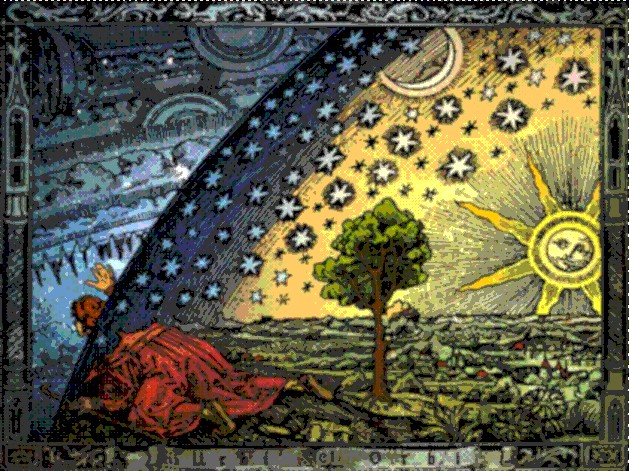
Introduction
Something changes. Before any theory, belief, or scientific model, we directly experience a world in transformation. This perception of change is our first contact with the Real. It constitutes the only irreducible certainty from which a path of understanding can begin.
From this minimal experience, one idea will be explored: that space, time, matter, thought, and consciousness could emerge from one same fundamental dynamic. The aim is not to adopt a pre-existing religious, metaphysical, or scientific system, but to let this first evidence — something changes — guide us toward its deepest consequences.
This text proposes a progression that is both imagistic and rigorous: to connect what science, philosophy, and inner experience often describe separately. The objective is not to state a dogma, but to test a hypothesis: if the Real proceeds from a single principle, can we, starting from the simplest, see the most complex emerge?
Note: Each image in this path is clickable. It opens the associated document, where the conceptual analysis, clarifications, and, when necessary, the corresponding formalism are presented. This makes it possible to move progressively from intuition to structure.
Methodology
Our perceptions can deceive us — illusion, interpretation, imagination. But there is one perception we cannot doubt: the perception of perceiving change. Even if everything else were illusion, the fact of perceiving a variation cannot be denied.
From this minimal certainty, a question arises: what must exist for this perception of change to be possible?
To designate what exists in itself, what makes space, matter, and consciousness possible, we will name CELA the substance of the Real. This name is deliberately neutral: it assumes neither belief nor prior theoretical framework.
The approach followed here has two stages:
- Deduce the attributes this substance must necessarily possess for the perception of change to be possible.
- Imagine this substance in its simplest state, then observe how its progressive complexification can generate space, time, matter, forces, life, and consciousness.
The objective is not to assert a definitive truth, but to evaluate the coherence of a single principle. If, from the simplest, the most complex can emerge without contradiction, then the model gains legitimacy.
Status and scope of the approach.
This work derives from no school and no pre-existing metaphysical system. It is not founded on a doctrine, but on direct attention to the Real: to perceive change, and to understand how it organizes itself into form.
The proposed model is conceptual and heuristic: not an experimental physical theory in the strict sense, but an architecture of intelligibility aimed at unifying physical, psychic, and symbolic phenomena within a single, non-contradictory framework.
The value of the model rests neither on tradition nor on authority, but on its generative power: the more it connects and clarifies without multiplying hypotheses, the closer it comes to the Real it seeks to express.
Attributes of the Substance of the Real
The term “substance” is used here in a strictly phenomenological sense: that which remains through change. CELA is not an ontological dogma, but a framework for thinking the continuity of the Real beyond its apparent forms.
Likewise, “to exist” does not imply the empirical existence of an object. To perceive a change is already to be in the presence of an effective difference. This difference is not a thing, but a minimal act of being. It is from this act that the notion of the Substance of the Real takes meaning.

The Substance of the Real designates everything that exists in itself. This does not posit its unity as a prior truth, but as a minimal hypothesis of coherence: if something escaped it, that something would exist in itself and would in turn have to be integrated. Thus, unity is deduced, not asserted.
- Alone: Nothing existing can be external to CELA. Every real distinction still belongs to its being.
- Eternal: Without external cause. Time is not what precedes it, but what arises from its variation.
- Indivisible: No internal boundary separates its being. The differences it bears are internal, not cuts.
- Continuous: Without rupture of being or ontological discontinuity.
- Sensitive: For a change to be perceived, there must be at least an internal differentiation in the substance. This distinction is already a form of sensitivity.
- Dynamic: Change has no external cause; it is the act by which the Real maintains itself. Time is the internal measure of this dynamism.
- Intelligible: What is distinguished can be described. Thought is not foreign to the Real: it expresses its internal coherence.
- Finite: Finitude is not an external limit, but the very condition of discernible existence.
- Immanent: The cause of the Real is not external to it; it resides in its own dynamic.
We thus obtain a substance that is alone, eternal, indivisible, continuous, sensitive, dynamic, intelligible, finite, and immanent — a unity without uniformity, capable of internal variations that generate forms, phenomena, and consciousness.
The test of such an ontology is not adherence, but its generative power: can it account for the world as it manifests, without internal contradiction?
Further reading
To examine the general foundations of the CdR model:
- image001 — The Passage from the Visible to the Invisible — Threshold of Inquiry
- image002 — Density and Complexity — Minimal Form of the Real
These documents establish the methodological opening and the first ontological core of the model: the passage from the visible to the invisible, then the minimal formulation of the relation between density, complexity, and the Real.