Astrophysics
CdR astrophysics takes over from cosmology: after the cycle of expansion, contraction, and Great Rebound, the Universe does not remain empty. It fills with structures that gradually transform into stars, galaxies, black holes, and extreme objects. This page tells how these forms appear, not as isolated accidents, but as different ways for CELA to organize its presence in space and time.
Rather than seeing the Universe as a setting in which pieces of matter would float, the Consciousness of the Real proposes seeing it as a living process. Clouds, stars, and galaxies then appear as knots of tension and release within one same field, constantly seeking an equilibrium between internal density and organization.
Quick reminder: In the CdR model, the Universe does not arise from a single Big Bang, but passes through cycles of expansion and contraction. As it approaches the Great Rebound, the regime simplifies down to a 5D threshold: there is then no stable matter, and what may remain are possibly radiative regimes, such as photons. After the rebound, the Universe passes again from 5D to 6D, then from 6D to 7D: it is within this passage that protomatter, the great disintegration, and the small matter surplus that initiates the astrophysical continuation appear. (To learn more, see the Cosmology section.)
From cosmology to the first structures
From cosmology to astrophysics
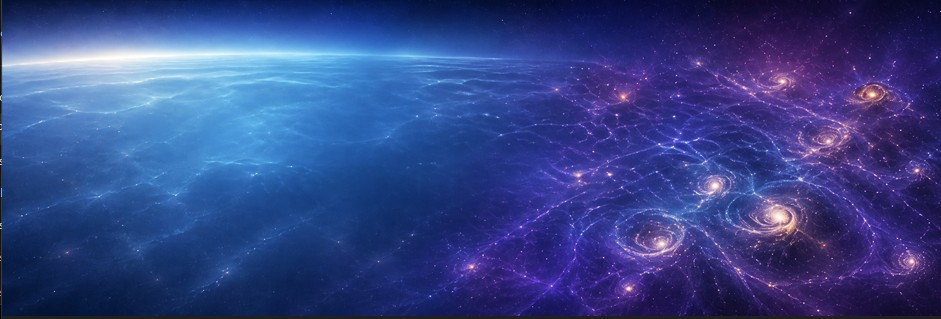
After the Great Rebound, the Universe is not yet filled with stars and galaxies. It looks more like a very uniform fog, where matter is distributed almost everywhere in the same way. At this scale, nothing yet seems to outline the future cosmic structures: no disks, no spiral arms, only a discrete soup of matter and energy.
Yet this apparent calm already hides the seed of everything that follows. Tiny irregularities, almost imperceptible, form: here a little more matter, there a little less. These minute differences — on the order of a few parts per million — will, as they are amplified over time, give rise to the great astrophysical structures.
First post-rebound contrasts
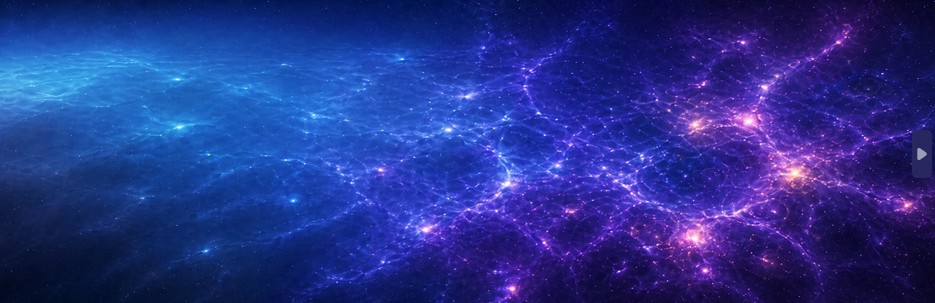
Where there is slightly more matter, spacetime deforms slightly: matter tends to make the field “flow” toward it. The more matter a region accumulates, the more it attracts what surrounds it. The initial fog therefore begins to clump: some zones gradually densify and become coherence wells where the Universe structures itself.
One could compare this process to a very fluid paste in which a few small bubbles form, then grow over time. Step by step, these wells attract more and more matter and draw the first outlines of future galaxies, long before light truly turns on in the Universe.
Post-rebound relief of the cosmic medium
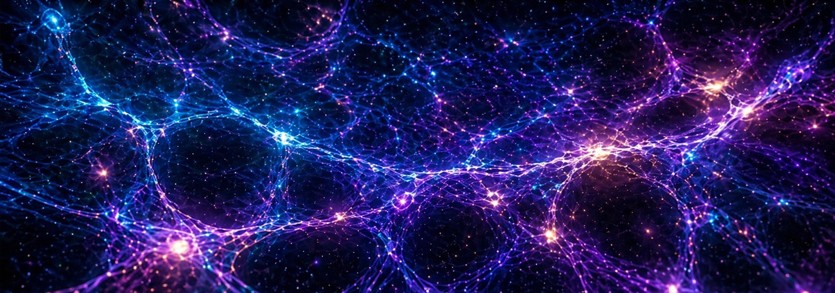
According to the Consciousness of the Real, a large part of the matter of the Universe — about 95% of the total mass-energy content — never shines: it does not emit light, does not form atoms like ours, but it weighs and shapes spacetime. This invisible component forms dark halos that surround the regions where ordinary matter concentrates.
The first proto-galaxies are born at the heart of these halos. Visible matter is still only a thin component there, guided by the gravitational framework of dark matter. Gradually, it begins to rotate, to fall inward in spirals, and to draw the disks and structures that we later associate with galaxies.
Stars, fusion, and enrichment of the medium
Once the first gravitational wells are established, astrophysics enters the stellar phase: contraction, ignition, internal structure, fusion, nucleosynthesis, and redistribution of elements.
Stellar ignition
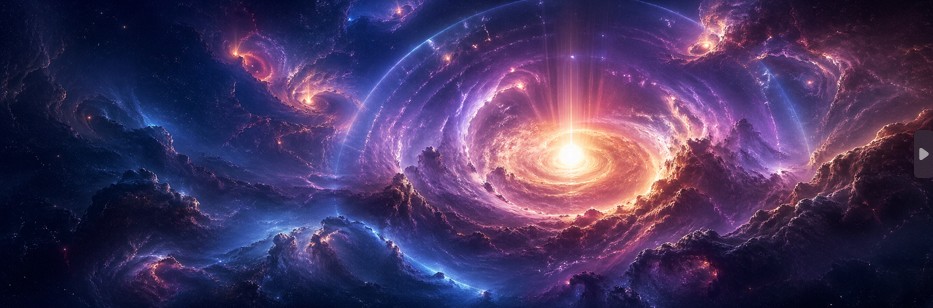
Inside proto-galaxies, great gas clouds contract under the effect of gravitation. As they tighten, matter heats up, collides, and its internal organization changes in nature. A moment comes when the core of the cloud crosses a threshold: when the temperature reaches about 10 million degrees, it becomes able to transform this compression durably into light.
This is the ignition of the first stars. Where there had been only cold and invisible matter, luminous points appear, announcing the end of the “cosmic dark age”. In the CdR vision, this passage does not depend only on temperature: it also reflects an internal coherence threshold of the Φ field, where accumulated tension converts into stable radiation.
Internal structure of stars
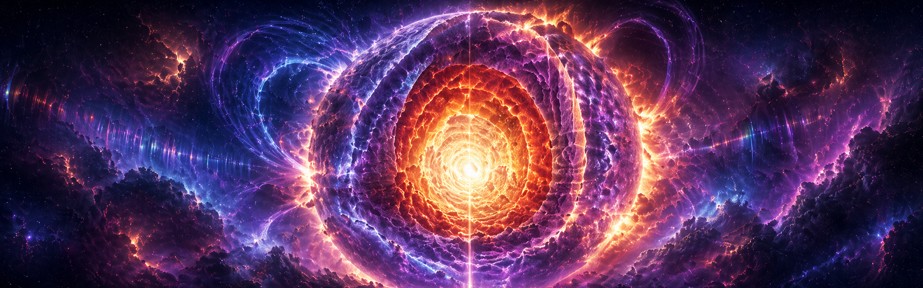
A star can be seen as a vast equilibrium between matter falling toward the center and light trying to escape from it. In the core, pressure and temperature are extreme: matter is so compressed that new forms of organization become possible, giving rise to reactions that release energy. For example, the Sun converts about 4 million tons of matter into pure energy every second.
From there, energy rises toward the surface through different layers, more or less turbulent. In the CdR vision, the interior of a star is not only a “nuclear furnace”, but a place where the fundamental field constantly reorganizes itself in order to maintain a form of global coherence, despite the enormous tensions it supports.
Stellar nucleosynthesis
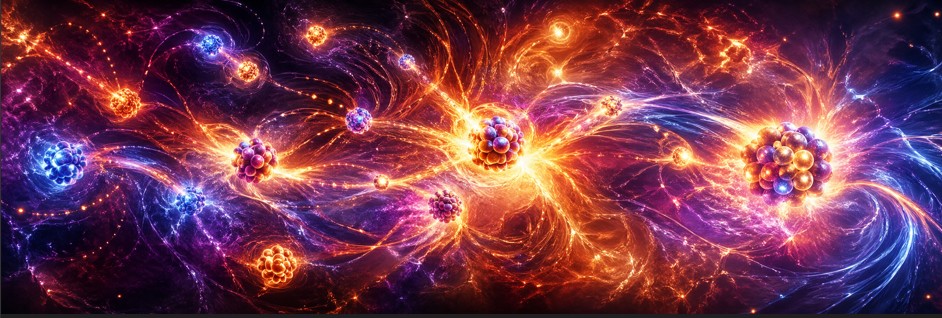
Over the course of its life, a star transforms part of its hydrogen into helium, then into heavier and heavier elements. These fusion cycles constitute a true cosmic alchemy: they produce carbon, oxygen, the calcium in our bones, and most of the elements present in our bodies and on our planet.
In the CdR framework, this production of elements is the natural consequence of a field seeking more stable forms of organization. A star is no longer merely a lamp hanging from the ceiling of the sky: it is a workshop where matter complexifies, step by step, all the way to the building blocks that will make the chemistry of life possible.
Supernovae
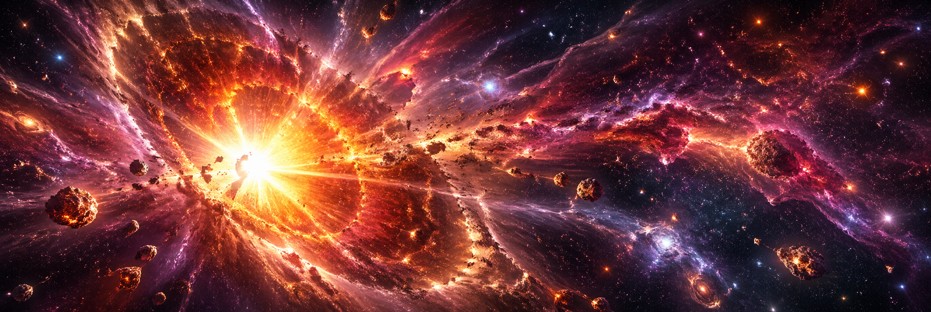
The most massive stars do not die gently. When their core can no longer support the weight of the upper layers, the whole structure collapses, then rebounds violently: this is a supernova explosion. For a short time, the star can shine brighter than the entire galaxy, releasing colossal energy — about 10⁵¹ ergs, the equivalent of what the Sun would radiate over 10 billion years.
In the CdR vision, this collapse is not only gravitational: it is also a sudden reorganization of the internal coherence of the Φ field, producing a rebound wave before the visible explosion itself. This spectacular ending has a fortunate consequence: it projects far away the heavy elements forged in the stellar core. Supernovae therefore enrich the interstellar medium and provide the raw material for new generations of stars, planets, and, later, living beings. The Universe recycles its own matter, cycle after cycle.
Compact objects and extreme phenomena
After stellar cycles and explosions, some regions reach extreme regimes: collapse, compactness, rotation, accretion, jets, and intermediate objects.
Black holes
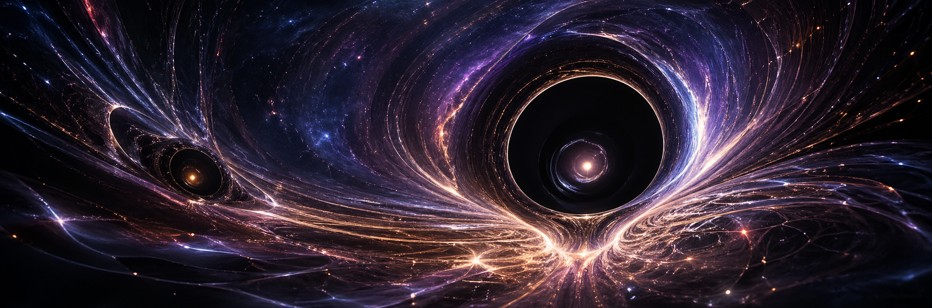
In some cases, the collapse of a massive star does not stop: matter contracts to the point of forming a black hole, concentrating the mass of several suns within a radius of only a few kilometers. Seen from outside, everything happens as though space itself were closing in, until it forms a boundary beyond which no light can return: the horizon.
In the Consciousness of the Real, a black hole is neither a simple “hole” nor a mathematical point without structure, but an extreme system of the Φ field. Collapse destroys complex systems — atoms, molecules, stars — and summarizes them in a unipolar vortex of radical simplicity. At the core, compression opens a transion: a passage point where the 6D flow of spacetime locally tears away and tips toward the 7D level. There is no infinite density, but a finite “drain of spations” that reduces internal complexity while remaining linked to the rest of the cosmos. The black hole thus plays the role of a deep recycler of matter, energy, and organization.
Accretion disks and relativistic jets
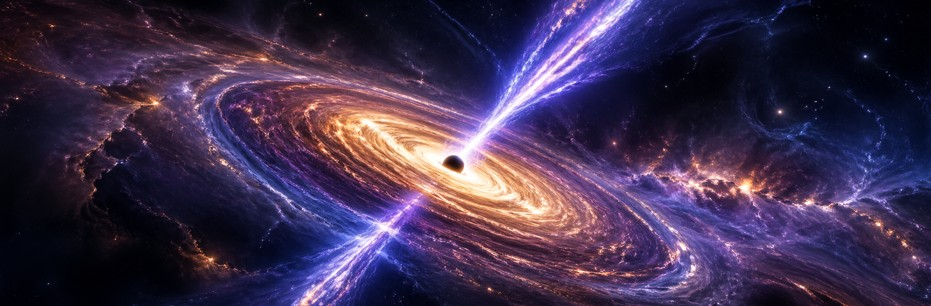
When a black hole attracts large quantities of gas, this gas does not always fall directly toward the center. It organizes itself into an accretion disk, extremely hot and luminous. Matter there rotates at speeds close to that of light, compressed by gravitation and by its own rotation.
In some cases, part of this energy is channeled into relativistic jets that shoot out from the poles of the system. These jets, visible over thousands of light-years, redistribute energy and matter on very large scales, influencing the evolution of entire galaxies.
Intermediate objects
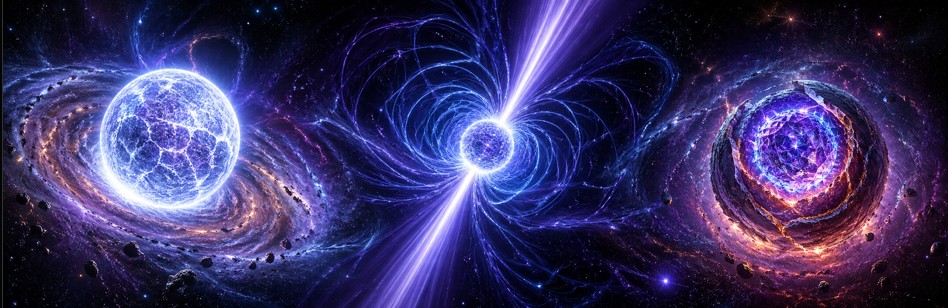
Between ordinary stars and black holes lies a whole bestiary of compact objects: pulsars with regular beams, sometimes rotating up to 700 times per second, neutron stars as dense as giant atomic nuclei, and perhaps other even more exotic forms. Each of these objects corresponds to a different way for the Universe to handle extreme conditions.
They are valuable for the Consciousness of the Real because they reveal how matter behaves when density, magnetic field, and gravitation reach their limits. In the CdR model, a pulsar is not merely a rotating magnetic dipole, but a Φ coherence oscillator that periodically modulates its internal organization. These objects are natural laboratories in which hypotheses about the deep structure of the Real can be tested.
Galaxies and observable signatures
At larger scales, compact objects, stars, and halos participate in the evolution of galaxies. This is also the scale where the block’s observable signatures can be grouped.
Evolution of galaxies over a cosmic cycle
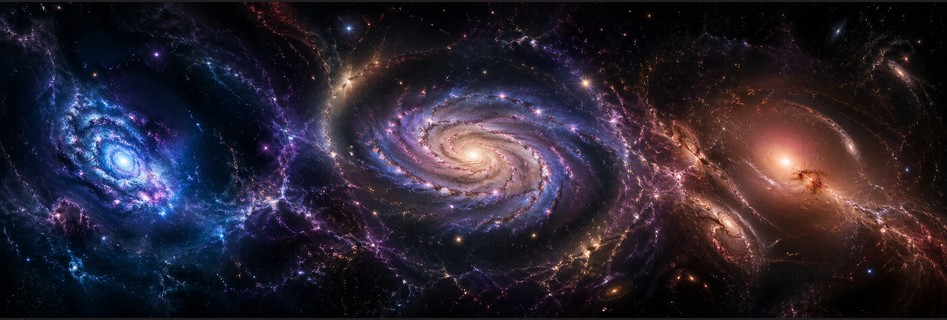
Galaxies too are born, live, and transform. The youngest are often compact and rich in gas; the oldest appear more spread out, with less available matter for forming new stars. Collisions, mergers, and gravitational interactions redraw their shapes over time.
From the CdR perspective, this evolution is not separated from the global cosmological cycle. Galaxies participate in the great overall movement: they concentrate matter and complexity during part of the cycle, then eventually redistribute what they have accumulated, helping prepare the conditions for a future rebound.
Observable signatures of CdR astrophysics
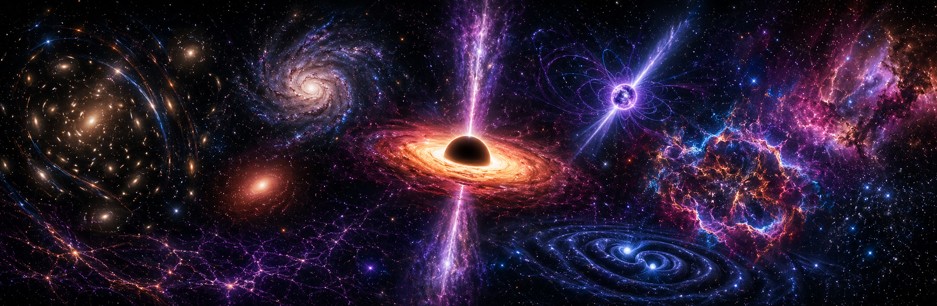
The ideas presented here do not replace observations: they propose another way of organizing and understanding them. Distribution of invisible matter, shape of halos, rotation speed of galaxies, properties of jets, abundance of heavy elements: all of these are clues that make it possible to test whether the CdR vision is compatible with what telescopes show.
For example, upcoming observations from the James Webb Space Telescope (JWST) could detect massive “dark” halos at very large distances, formed before the first stars — a specific prediction of the CdR model. Likewise, precision measurements by the Event Horizon Telescope (EHT) of the black holes M87* and Sagittarius A* will make it possible to check whether their internal structure corresponds to a “compact 6D core” rather than to a classical singularity. Gravitational-wave detectors such as LIGO and Virgo will also be able to test CdR predictions concerning the vibration modes of black holes during mergers.
By connecting astrophysics to cosmology through one same principle of immanence, the Consciousness of the Real invites us to see the Universe as a coherent whole. From large structures to the details of extreme objects, the same movement seems to be at work: CELA seeks itself, tenses, relaxes, and reorganizes itself, cycle after cycle, in light and in shadow.
Further reading
This popularized presentation is based on the technical documents of the Astrophysics series:
- image080 — From cosmology to astrophysics — post-rebound protomatter
- image081 — First post-rebound contrasts — amplification and beginning of structures
- image082 — Post-rebound relief of the cosmic medium — basins, ridges, filaments and void bubbles
- image083 — Stellar ignition — internal thresholds of the Φ field
- image084 — Internal structure of stars — core, transport and coherence regimes
- image085 — Stellar nucleosynthesis — nuclear coherence and core transformations
- image086 — Supernovae — coherence rupture and redistribution of matter
- image087 — Black holes — unipolar transion and spationic transit
- image088 — Accretion disks and relativistic jets — rotation, transit and axial evacuation
- image089 — Intermediate objects — pulsars, neutron stars, exotic cores
- image090 — Evolution of galaxies over a cosmic cycle
- image091 — Observable signatures of CdR astrophysics
These documents detail the passage from post-rebound protomatter to the first contrasts, cosmic relief, stellar ignition, stellar structure, nucleosynthesis, supernovae, black holes, compact objects, galaxies, and observable signatures in the CdR framework.