Biology
Biology begins when chemical organizations become systems capable of maintaining their own coherence over time.
In the standard framework, it studies cells, membranes, flows of energy and matter, metabolisms, genetic information, reproduction, evolution, development, organisms, nervous systems, and ecosystems.
In Consciousness of the Real, this description is not replaced. It is reread as the progressive emergence of increasingly encompassing material systems, where local subsystems preserve their own dynamics while being coordinated by higher organizations.
The principle of caution remains central:
without an operational quantity, no independent prediction; without a criterion of maintenance, no threshold of life.
This page therefore presents, for each stage, the recognized biological foundations and then what CdR adds as a structural reading.
From prebiotic chemistry to life
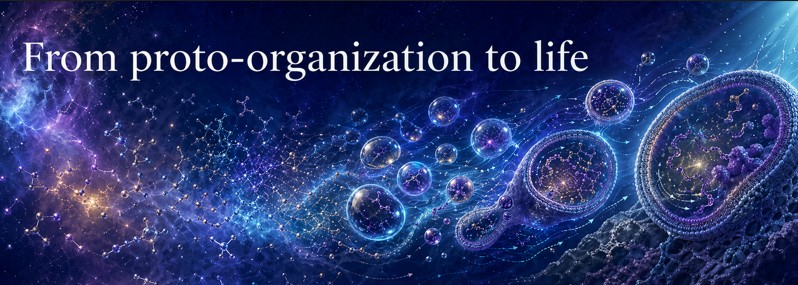
From proto-organization to life — systems, flows and self-maintenance
The standard basis is that life does not arise from an isolated molecule. It presupposes reaction networks, flows of energy and matter, gradients, compartments, cycles, stability constraints, and some capacity for persistence.
Prebiotic chemistry prepares this transition, but it is not sufficient by itself. One must distinguish:
- organic molecules;
- reaction networks;
- autocatalytic cycles;
- compartments;
- proto-metabolisms;
- systems capable of maintenance;
- fully constituted cells.
What CdR adds:
a point of attention of CELA first bears on a system, not on an isolated object.
A material system can be understood as a unit of local coherence: it maintains certain internal relations, exchanges with its neighborhood, and remains subject to distant constraints. This reading extends the Local–Neighbors–Distants principle already present in spation dynamics.
Life would begin when chemical systems become capable of maintaining a boundary, channeling flows, preserving a memory, selecting certain transformations, and preserving their continuity.
This proposal does not yet derive life. It only defines the type of threshold that the Biology block must examine.
Biological compartmentalization — membranes, gradients and individuation
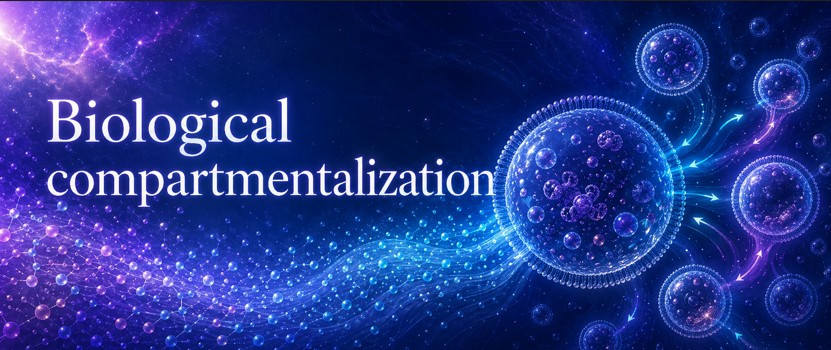
The standard basis is that compartmentalization plays a major role in the origin and functioning of living systems. A membrane or interface does not only separate. It makes it possible to maintain gradients, control exchanges, and distinguish an inside from an outside.
Without a compartment, a chemical network remains largely diffuse. With a compartment, it can acquire a local history: certain concentrations, reactions, and internal conditions can be preserved longer than in the external medium.
What CdR adds:
compartmentalization transforms a chemical network into a locally situated system.
The minimal living system is not defined only by what it contains, but by its capacity to organize exchanges between local, neighbors, and distants:
- the local: internal medium, gradients, cycles, intrinsic constraints;
- the neighbors: membrane, interfaces, immediate exchanges;
- the distants: environment, global flows, geochemical cycles, planetary conditions.
A vesicle or compartment is not yet an organism. Compartmentalization becomes biologically relevant when it couples to flows, cycles, and a capacity for maintenance.
Proto-metabolisms — cycles, couplings and out-of-equilibrium persistence
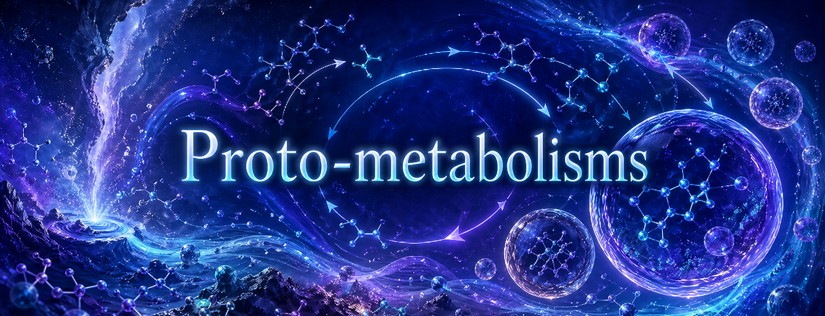
The standard basis is that a metabolism is not a simple accumulation of reactions. It involves cycles, couplings, flows, catalysts, potential differences, and out-of-equilibrium organization.
In a proto-metabolism, some reactions can maintain the conditions of other reactions. Unfavorable transformations can become possible through coupling. Gradients can be exploited as sources of local work.
What CdR adds:
a proto-metabolism can be reread as a system of flows capable of transforming external differences into internal maintenance of organization.
The general formula of the transition becomes:
This maintenance is not immobility. It is a dynamic stability: components change, but the global organization persists.
CdR does not yet derive metabolic pathways. It proposes a structural reading of proto-metabolisms as networks of couplings, thresholds, and persistence.
Information, memory and selection
Informational polymers — sequences, chemical memory and transmission
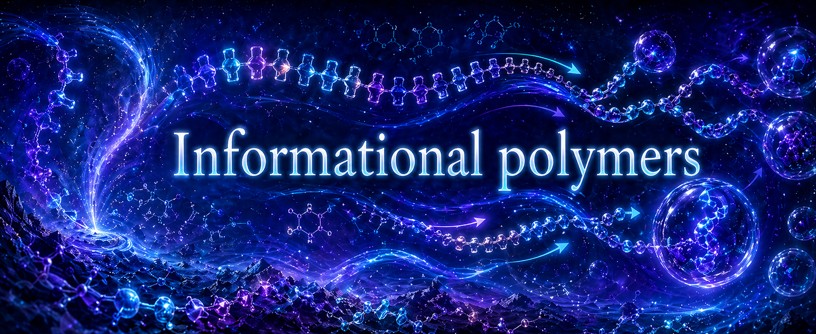
The standard basis is that certain polymers can carry a sequence. This sequence can preserve chemical information, influence interactions, and be transmitted with more or less fidelity.
RNA plays a central role in several hypotheses on the origin of life, because it can both carry a sequence and participate in certain catalytic activities. But biological information must not be reduced to an abstract symbol: it remains carried by material structures.
What CdR adds:
biological information appears when a material organization becomes capable of preserving a transmissible constraint.
A sequence becomes biologically relevant when it influences the conservation, reproduction, or stabilization of the system that carries it.
The minimal relation can be formulated as follows:
CdR does not derive the origin of RNA or of the genetic code. It situates information as a regime of material memory capable of orienting subsequent transformations.
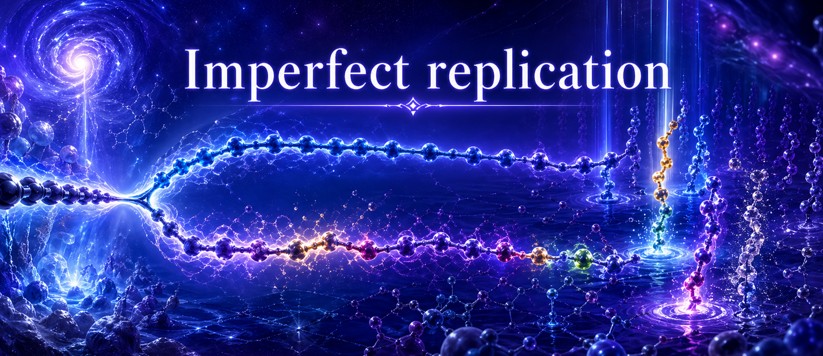
Imperfect replication — variation, conservation and pre-Darwinian selection
The standard basis is that evolution requires a tension between conservation and variation. Perfectly identical replication produces no novelty. Replication that is too inaccurate destroys continuity.
Before fully biological Darwinian selection, weaker regimes of selection can exist: some networks, compartments, or polymers persist better, reproduce better, or stabilize their local environment better.
What CdR adds:
pre-Darwinian selection begins when several material organizations do not have the same capacity to maintain and transmit their coherence.
Imperfect replication then becomes an important threshold. It allows an organization to preserve a general form while exploring variants.
The minimal structure is:
One must not immediately project full Darwinian selection onto prebiotic systems. Before organisms, forms of selection can exist that are linked to stability, partial reproduction, and resistance to perturbations.
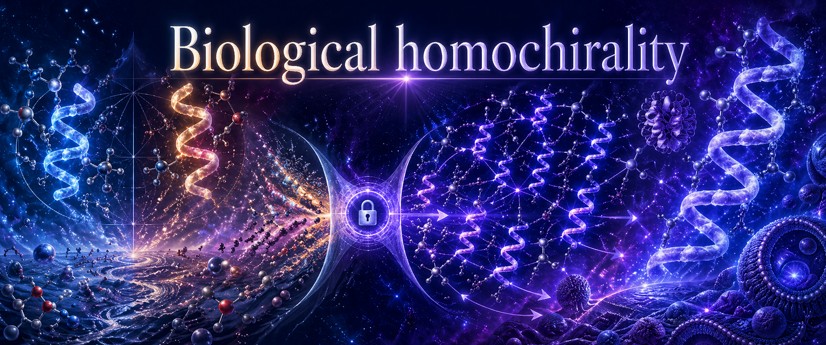
Biological homochirality — amplification, locking and shared orientation
The standard basis is that some molecules exist in two non-superimposable chiral forms. In known life, chiral orientation is strongly selected: amino acids are predominantly of the L type, and biological sugars predominantly of the D type.
Homochirality is not reducible to a local property of a molecule. It becomes biologically decisive when one orientation is amplified, stabilized, and transmitted throughout an entire network.
What CdR adds:
biological homochirality can be reread as the collective locking of a molecular orientation in a system capable of amplifying it.
The CdR question must remain cautious. It is not a matter of claiming that biological chirality has already been derived from a fundamental asymmetry of the corpus. The open question is rather:
can a local asymmetry be amplified until it becomes a global network constraint?
Chiral autocatalytic reactions then become a priority test terrain.
Cell and regulation of living systems
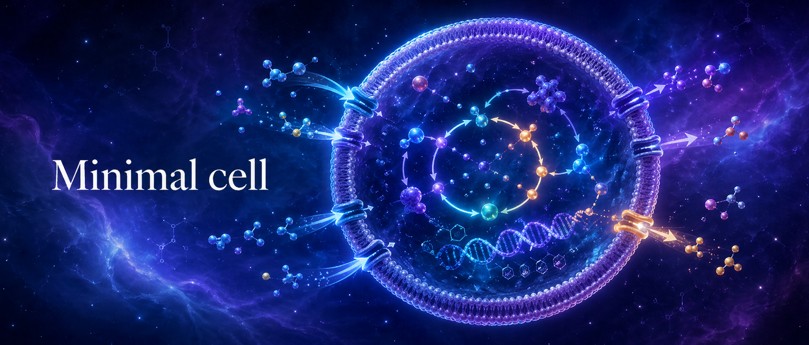
Minimal cell — integration of compartment, metabolism, information and transmission
The standard basis is that a minimal cell must integrate several functions: compartmentalization, metabolism, information, exchange with the medium, and reproduction or participation in a lineage.
A cell is not a closed system. It exchanges matter and energy with its environment. But it is partially closed from the standpoint of its organization: some internal processes contribute to maintaining the conditions that make them possible.
What CdR adds:
the minimal cell can be understood as an encompassing system that coordinates molecular, membrane, metabolic, and informational subsystems.
Operational closure does not mean isolation. It means that internal organization forms a maintenance loop:
In this reading, the cell is not a thing added to chemistry. It is a higher systemic level, capable of coordinating chemical processes without abolishing them.
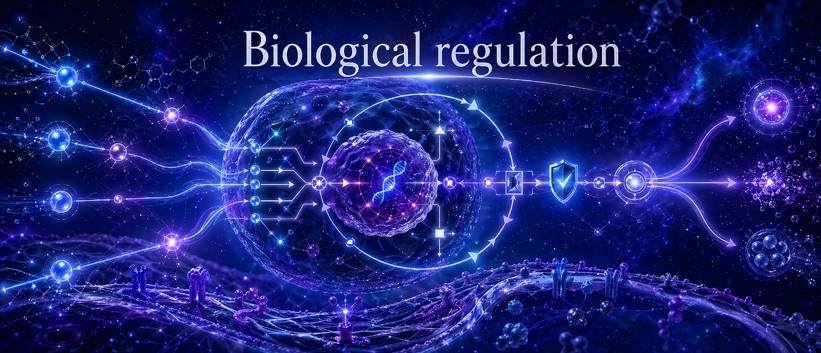
Biological regulation — thresholds, feedback and dynamic stability
The standard basis is that living systems regulate their internal states through feedback loops. They can activate, inhibit, amplify, dampen, open, or close certain paths.
Regulation transforms a reaction into a response. It allows a living system not only to undergo variations in the medium, but to modulate its own processes.
What CdR adds:
biological regulation appears when the internal organization of the system can orient its own flows.
This orientation proceeds through thresholds, bifurcations, inhibitions, amplifications, and stabilizations. A small signal can produce a major reorganization if the system is close to a threshold.
The minimal structure is:
CdR must not confuse biological regulation with intention. A regulation loop is not reflexive consciousness. It is an organized dynamic constraint.
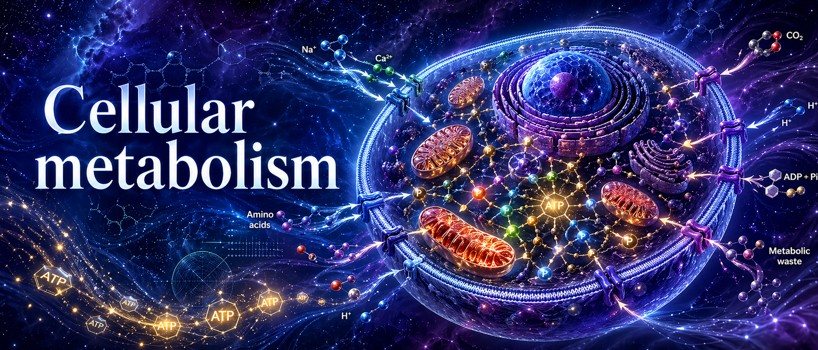
Cellular metabolism — energy, flows and maintenance of organization
The standard basis is that cellular metabolism transforms matter and energy in order to maintain the organization of living systems. It includes synthesis, degradation, storage, transport, and energy-conversion pathways.
Ion gradients, membranes, enzymes, ATP, transporters, and reaction networks allow the cell to remain far from equilibrium while continually renewing its components.
What CdR adds:
cellular metabolism can be reread as the continuous conversion of external flows into internal maintenance of organization.
The cell does not possess its organization once and for all. It continually rebuilds it.
The central relation is:
CdR does not replace biochemistry. It proposes a structural reading of metabolism as a network of maintenance under constraint.
Evolution and complexification
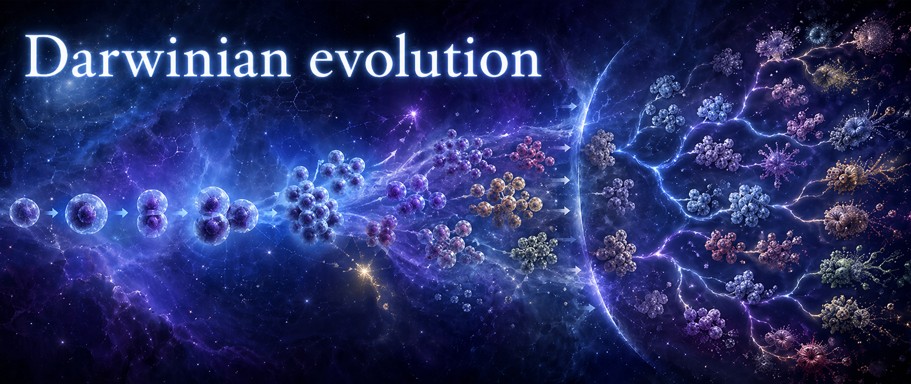
Darwinian evolution — populations, mutations and cumulative selection
The standard basis is that Darwinian evolution rests on variation, heritability, and differential selection. It unfolds in populations, across generations, according to historical and environmental constraints.
Mutations are not directed toward a goal. Selection does not aim at global perfection. It locally favors certain variants in certain environments.
What CdR adds:
evolution can be reread as the historical transformation of living systems subject to reproduction, variation, and environmental constraints.
Cumulative selection allows locally better adapted organizations to persist, but it does not guarantee an automatic rise toward complexity.
Caution is therefore essential:
possible complexification does not mean necessary progress.
CdR must distinguish local adaptation, lineage stability, diversification, specialization, and complexification.
Genetic code — translation, robustness and sequence-function correspondence
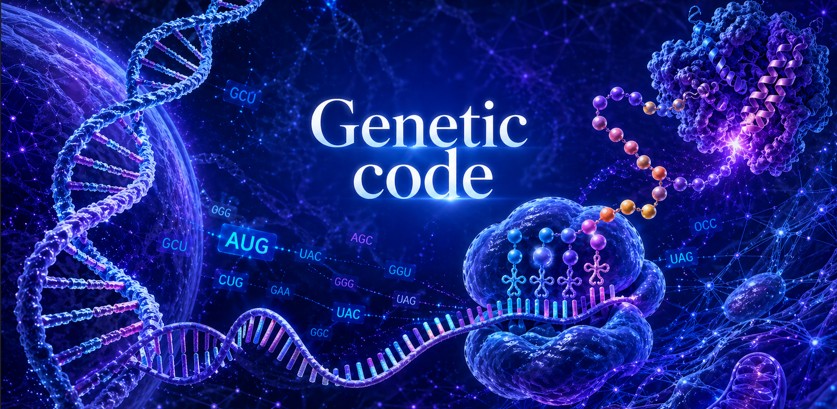
The standard basis is that the genetic code links nucleotide triplets, or codons, to the amino acids used to build proteins. It is the bridge between sequential memory and biological function.
This code is nearly universal, redundant, and relatively robust to errors: several codons can correspond to the same amino acid, and some single-nucleotide errors produce less destructive substitutions than a fully random code would.
What CdR adds:
the genetic code can be reread as a robust translation lock between sequence, function, and heritability.
CdR must not claim to have already derived the genetic code. The open question is rather:
can a sequence-function correspondence stabilize because it reduces the destructive effects of error while allowing functional transmission?
The genetic code therefore completes the passage:
This step is necessary in order not to move too quickly from chemical information to cumulative evolution.
Biological complexification — differentiation, cooperation and scale constraints
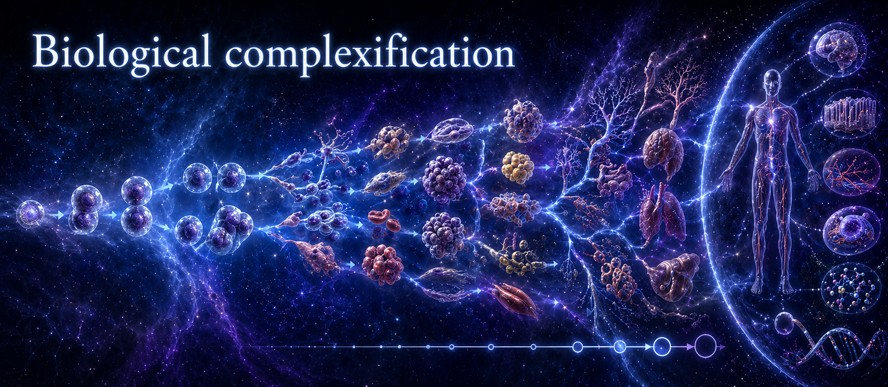
The standard basis is that biological complexity can take several forms: genetic, cellular, morphological, functional, behavioral, or ecological complexity.
It can increase in some lineages, but it can also stabilize, decrease, or simplify. Complexity has costs: energy, coordination, vulnerability, slower reproduction, and internal conflicts.
What CdR adds:
biological complexification corresponds to the integration of differentiated subsystems into a more encompassing coherence.
A higher level appears when several local systems become subsystems of a wider organization, capable of coordinating them without dissolving them.
The working relation is:
This reading joins the central intuition of the block: a point of attention of CELA bears on a system, and a more encompassing system can make a higher focus of coherence appear.
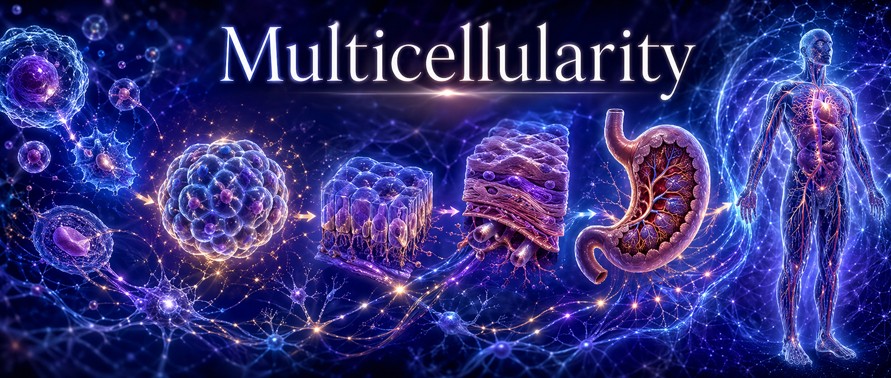
Multicellularity — coordination, specialization and integration of life
The standard basis is that multicellularity does not consist only in bringing several cells together. It presupposes adhesion, communication, coordination, specialization, division of labor, and control of internal conflicts.
A multicellular organism is an integrated unit composed of cellular subsystems that preserve relative autonomy while participating in a higher organization.
What CdR adds:
multicellularity is a threshold of systemic encompassing.
Cells become subsystems of an organism when their own maintenance is partially subordinated to the coherence of the whole.
The minimal structure is:
The relative autonomy of cells must not be erased. A multicellular organism is an integration, not a simple fusion.
Complex living forms
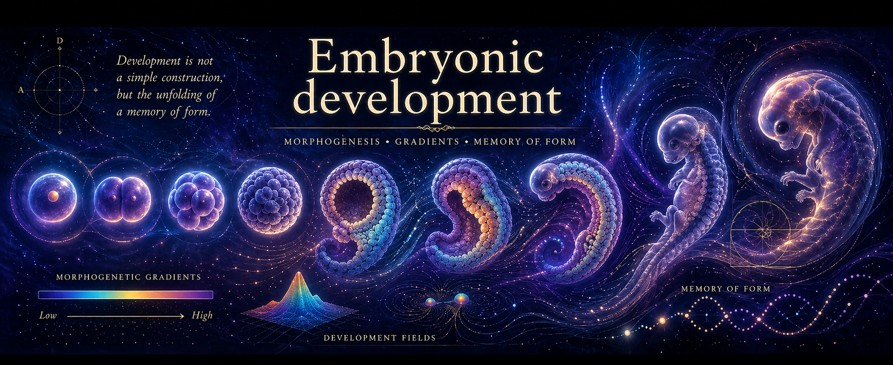
Embryonic development — morphogenesis, gradients and memory of form
The standard basis is that development transforms an initial cell into a structured organism. It mobilizes cell divisions, differentiation, gradients, signals, mechanical constraints, genetic regulation, and interactions between tissues.
Genes are not a detailed plan in the mechanical sense. They participate in a wider developmental system, where form emerges from regulated interactions.
What CdR adds:
embryonic development can be reread as a progressive stabilization of forms through gradients, regulations, local constraints, and organizational memory.
Living form is not simply imposed from outside. It is built through interactions between subsystems, according to local, neighboring, and distant constraints.
The reading structure is:
CdR does not derive biological forms. It proposes a systemic reading of morphogenesis as the progressive organization of a living field.
Nervous systems — integration, command and organized response
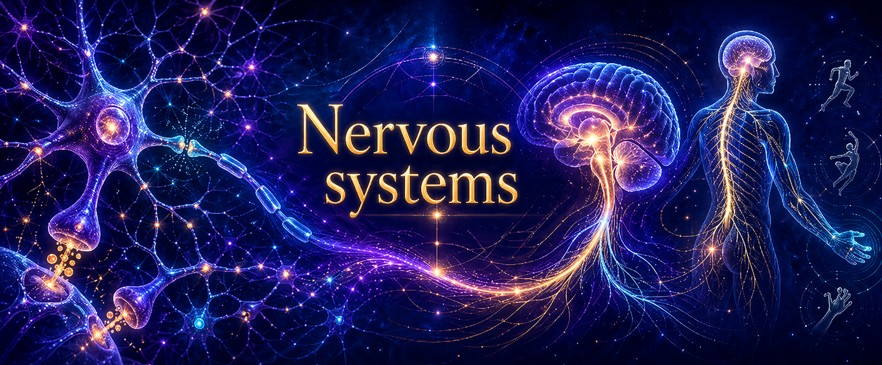
The standard basis is that nervous systems coordinate perception, integration, memory, motor command, and response to the medium. They rely on neurons, synapses, electrochemical signals, networks, and sensorimotor loops.
A neuron activates when its membrane potential reaches a threshold. This activation involves ionic flows, channels, gradients, and local amplification.
What CdR adds:
the nervous system is a specialized biological level of integration and command, not the absolute origin of CELA’s attention.
In the CdR framework, minimal attention already accompanies systems as focuses of coherence. The nervous system nevertheless allows an advanced form of integration: it links perception, memory, anticipation, action, and coordination of the body.
The minimal structure is:
This document must not yet treat human reflexive consciousness directly. It only prepares the biological terrain: excitation, signal, integration, coordination, and command.
Ecosystems — trophic networks, cycles and relational stability
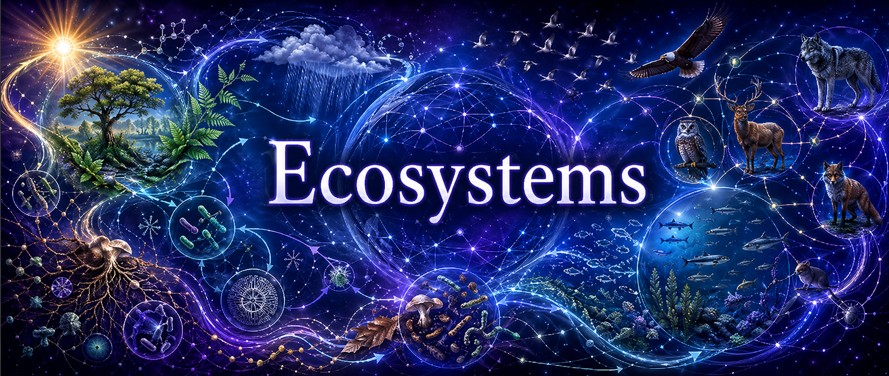
The standard basis is that organisms do not live in isolation. They participate in ecosystems composed of trophic networks, matter cycles, energy flows, symbiotic relations, competitions, predations, and environmental feedback.
A stable ecosystem is not immobile. It maintains itself through continuous transformations, compensations, adaptations, and redistributions.
What CdR adds:
an ecosystem can be reread as a distributed living system, where biological organizations redistribute flows of matter and energy.
One must remain cautious: an ecosystem is not a single organism in the strict sense. It is a distributed relational organization, composed of multiple interdependent living systems.
The Local–Neighbors–Distants structure becomes especially visible here:
- local: organism or population;
- neighbors: immediate ecological relations;
- distants: climate, planetary cycles, geology, global perturbations.
Observable signatures
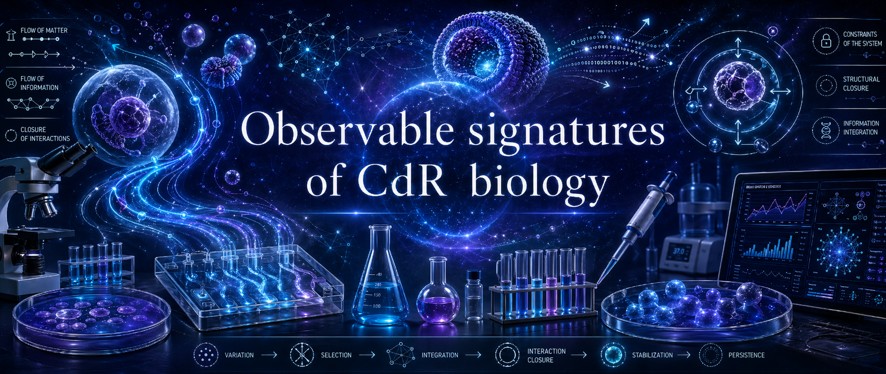
Observable signatures of CdR biology — flows, information, closure and constraints
The standard basis is that biology already has powerful tools for observation and measurement: microscopy, genomics, transcriptomics, proteomics, metabolomics, membrane biophysics, electrophysiology, network modeling, quantitative ecology, and protocell experiments.
What CdR adds:
these tools can serve to progressively constrain CdR biological quantities, provided that operational observables are defined first.
The first candidates must not be too vast. One must begin with simple systems where flows, thresholds, stability, memory, and closure can be measured.
Candidate systems:
- vesicles and protocells;
- autocatalytic networks;
- chiral autocatalytic reactions;
- informational polymers;
- minimal cells;
- models of out-of-equilibrium metabolism;
- simple regulatory networks;
- highly controlled multicellular systems.
The formula of caution for the Biology block is therefore:
without an operational quantity of maintenance, flow, or information, no independent biological prediction.
Synthesis
The Biology block establishes a progressive passage:
CdR biology does not replace standard biology. It seeks to reformulate its main phenomena as regimes of systemic integration, maintenance, memory, selection, and coordination.
Its main contribution, at this stage, is not a new quantitative prediction. It is an architecture of questions:
- how does a chemical system become capable of maintenance?
- how does a boundary transform a diffuse network into a local system?
- how do flows become cycles?
- how does a material trace become transmissible information?
- how does a sequence become a transmissible function through the genetic code?
- how do variation and conservation produce selection?
- how do subsystems become coordinated by a more encompassing system?
- how can (C), (C_{\mathrm{ext}}), flow, closure, memory, and maintenance be defined in a genuinely operational way?
The next step will have to transform these questions into calculable quantities and measurable tests.
Further reading
This introductory presentation is based on the technical documents of the Biology series:
- image120 — From proto-organization to life — systems, flows and self-maintenance
- image121 — Biological compartmentalization — membranes, gradients and individuation
- image122 — Proto-metabolisms — cycles, couplings and out-of-equilibrium persistence
- image123 — Informational polymers — sequences, chemical memory and transmission
- image124 — Imperfect replication — variation, conservation and pre-Darwinian selection
- image125 — Biological homochirality — amplification, locking and shared orientation
- image126 — Minimal cell — integration of compartment, metabolism, information and transmission
- image127 — Biological regulation — thresholds, feedback and dynamic stability
- image128 — Cellular metabolism — energy, flows and maintenance of organization
- image129 — Darwinian evolution — populations, mutations and cumulative selection
- image130 — Genetic code — translation, robustness and sequence-function correspondence
- image131 — Biological complexification — differentiation, cooperation and scale constraints
- image132 — Multicellularity — coordination, specialization and integration of life
- image133 — Embryonic development — morphogenesis, gradients and memory of form
- image134 — Nervous systems — integration, command and organized response
- image135 — Ecosystems — trophic networks, cycles and relational stability
- image136 — Observable signatures of CdR biology — flows, information, closure and constraints
These documents present the passage from prebiotic chemical systems to living forms: compartmentalization, flows, proto-metabolisms, information, memory, selection, cell, evolution, complexification, nervous systems, and ecosystems.